Friday, November 16, 2012

The Power of a Playing Parent


“For it is God who works in you to will and to act according to His good purpose.  Do everything without complaining or arguing, so that you may become blameless and pure, children of God without fault in a wicked and deprived generation, in which you shine like stars in the universe as you hold out the word of life…”Phil. 2:13-16a
I’ve been thinking lately about soccer and our involvement with our kids in this sport.  I suppose a title could be:

The Power of a Playing Parent


When you sign your son or daughter up for AYSO (American Youth Soccer Organization), it really is as if you are playing.  You could just drop them off and disappear for the two practices a week, but with younger kids that is discouraged.  So, if you are on the premises, you may as well participate. You could sit there and complain about having to go to all of those games, or you could be an encouragement on the sideline.  I want to always be an active parent on the side line of soccer.  I want to cheer loudly when Jo Jo gets the ball, and take notice when he’s even close to getting the ball. When he makes a good play, I want to let the world know, “That’s my kid that just did that assist!”  Though my son may not be a star, I want to cheer him on like he is one.
What I realized this last week-end is that when we go to the games and cheer on our team, we are a shining force.  Even if they lose, they feel like winners when the parents go nuts when any of them does a great corner kick, or save, or head.  I want to be a star in the way I shine on that sideline.  I want to jump in and do the flagging, or fill out the game card, or organize snacks as the Team Mom. 
And how much more of a chance to do that here on this island. 
After a few seasons here in Kona AYSO, you recognize kids and the coaches.  If you don’t get out of the way, you just may get talked into being a coach.  It happened to me two years ago.  I showed up at a parent volunteer meeting saying I wanted to be an assistant coach for the U-8 (under age eight) team.  I somehow walked out being the head coach of Evan’s U-12 team.  Yep. I ended up forever drafted into the kids’ Hall of Fame here in Kona.   I still remember each of those boys’ names.  To this day when I run into Ezra’s mom at Target, or Justin at the theater, or Tui at the Easter Sunrise service I am “coach” to them.
The thing is, that happens even when you’re not coaching.  By just being present, you learn the name of all ten kids on your kid’s team.  You know who is best for taking penalty kicks, and who you don’t want to put in as goalie.  You also get to know the parents. 
This last weekend at the giant end-of-season party, I saw so much cheering by the parents, I figured the lines were fuzzy, and we were just cheering on all of our kids at once.  When Team Dynomite donned their cylinder cardboard crackers, I was cheering.  My husband was shooting photos.  When the Blue Angels strolled out with 3-D cardboard airplanes tied over their shoulders, we were all in wonder.  Every boy that has played on our sons' teams in the past was cheered on by name when his team banner walked by.   I daresay the parents were having as much fun as the kids.
There were some parents who came late, grumbled about the loud music, or sat in their lawn chairs the whole time.  Yet others circulated, thumped coaches on the back, laughed at the kids’ antics, and enjoyed each other.  “For it is God who works in you to will and to act for His good pleasure.”
As I walked around the giant soccer field under the lights that evening, I thought, “Wow.  Half of Kona is here.”  I knew there was a Coffee Festival going on with a parade, but it seemed that half of the working class people of Kona were at that soccer field.  What a chance for impact!  What an opportunity to shine!
I saw many YWAM friends shining like stars that evening, holding out life.  Two dads stood around and got to know an artist dad who crafted the aforementioned Blue Angels get-up.  Moms combined their artistic ability to create the team banner, and pooled their money to secure a Mahalo gift for the coach.  Though we may have been on opposite sides of the field during the season, we were all at the same potluck at the end:  feasting, photographing, and dancing.
My first end-of-soccer dance party, I stood on the side and watched the parents and kids dance. My second year, I wandered in to the mix, trying out a few moves.  This last weekend, I was alongside my son’s coach, attempting  Zumba.  A YWAMer mom was on my left and later one on my right.  I noticed one mom in particular going crazy out there, blond curls bouncing, as she tried to keep up with her U-6 son.  “I’m out here because my son asked me to be his dance partner.”  I recognized her later as someone from my church. 
One coach stood on the side of the dance circle, a lei around his neck.  At his U-14 girls’ urging, he jumped into the dance circle and launched into his best robot dance.  Who was this guy?  The assistant pastor of Living HopeChurch
I believe there is more to this than meets the eye.  The whole of AYSO happens from volunteers.  But more than that, friendships are forged.  I have a new running partner, a mom who recently went through a divorce and who has just started attending church again.   Over increased years in this sport, we have galvanized friendships with parents. We know their names.  Something of light and life has rubbed off by the power of parents in the game. 


Thursday, August 30, 2012

Palau #3 and last: Big Fish in a Small Pond


PALAU: BIG FISH IN A SMALL POND                                                                         8/6/12

“I think you’re going to like Poulsbo, Kris.  It’s a chance for you to be a big fish in a small town.” I was in sixth grade.  We were moving from the growing suburb of Bellevue, Washington to the very small town of Poulsbo.  How true my dad was.  Within a few years, I was able to land decent roles in the school plays in high school, and to get playing time on the basketball team and varsity track team, and serve as a student body officer.  I probably would have been lost in the crowd at Bellevue High School. 

My father’s words float out to me now as I sit a few degrees above the Equator in the tiny island nation of Palau.  The population of this whole country is about twice the size of Poulsbo today. Each day something happens that is “big-fish-ish.”  For a middle-aged American on a five-week mission in Palau to improve education, I’m getting more than I bargained for. 

One reason for this is there is no elitism.  There are no gated communities, no Streets of Dreams or “the” neighborhoods to get into.  My first hint was our neighbors in Airai, the state just north of the most-populated area, Koror State, where I teach each day.  We live in the nice home of a YWAM friend named Jacqui.  We have three neighbors.  One is Jacqui’s sister.  No surprise in this community-oriented culture to have family nearby.  The other two neighbors were a surprise:  one is a senator, the other, the Minister of Interior.  What?!  There is no way a senator and member of the cabinet would be living on my street in the U.S.  This is like living on Downing Street in London. 

After the conversations I’ve had in the last 24 hours, it's also like being a graduate of Harvard.  And Yale.   It seems that nothing is exempt for us.  No part of this country or society, no matter how big or small, is unavailable to us.  We aren’t a big fish in a small pond.  We are a rowboat in a mud puddle.  Any place I want to jump off this ship is open-game.  I can’t believe it.  Two weeks ago, a visit to my friend Fuana’s company BBQ became a chance to meet the President and his VP, stopping by on their campaign tour. 

I’m finding that “with great privilege comes great responsibility,” as King Henry says to his son in one of my favorite chick-flicks, Ever After.  I can essentially be a super-hero here.  I can use any talent or connection for good, or for evil.  For the benefit of a large number of people, or for myself.  I hope I am choosing well.  

Recently, I was invited to speak at a women’s prayer breakfast. I told them of what happened when we gathered people to pray for the local high schools in the Portland area and in Hawaii, and how they, too, could see statistical change as they pray and care about their local schools.  After my short talk, the woman next to me struck up a conversation.  We decided to pray together when they encouraged us to find a partner.  This woman was going through a struggle, stemming from trying to re-group after the assassination of her father.  Who was her father?  The former president of Palau! 
Another woman greeted me warmly.  I asked Chen what her line of work was.  Chen’s answer was a long one:  “I own a lounge in town, and a flower shop.  I also provide oxygen tanks to the local hospitals.”  The woman next to Chen added that she owns a hotel as well, and a restaurant, and a gas company.  I asked Chen which business she liked the best.  “The dress shop.”  Dress shop?  She didn’t mention that one.  That became the inspiration for her going-away gift for me.  I have loaned her one of my dresses, and she will have her speedy Chinese dress-maker fashion me a dress before I leave in less than a week.  Unreal. 

We decided to visit the capitol buildings, which are only six years old and fashioned after our capitol in D.C.  I was hoping we could get a tour of the inside.  We did.  We met the security guy, who readily gave us a tour of the interior, took us up above the senate, and through the electrical room to the outside of the dome.  From that vantage point, we had a clear view of miles in every direction, and were able to pray for the Palauns, that their government would make just laws and decisions.
Our boys wanted to see a crocodile.  Fuana knew of a YWAM friend who owned one that he’d caught as a baby.   The croc is now huge, as is the gentleman’s influence:  he currently is a senator in his northern state!

Around this time, I grabbed lunch at our favorite internet cafĂ© in Palau.  An American gentleman in his 60’s sat near me, reading a book about Catholicism in Palau.  When my favorite waitress struck up a conversation with me about an article I wrote in the paper—honoring the owner of a local laundry business—his curiosity was piqued.  He could tell I wasn’t a tourist.   When the waitress let me know that this laundrywoman had a large brain tumor, I was hit with compassion.  “We ought to send some people her way to pray for her!” 

“That’s exactly what she needs!” added the gentleman.  I learned that this man, also, was on-loan from America for a month in a volunteer teaching capacity. 

“Do you mind if I join you?”  I nodded.  This kind-hearted gentleman had retired from teaching in San Francisco to set out to use his giftings for greater purposes in the Pacific.  We exchanged notes.  He had just spent his second summer teaching the Chukese math (on another Micronesian island), and I was finishing up my last week teaching teachers from Palau and Yap here in Palau.  Through his connection with various Catholic missions, Bob Scavullo had come to the same conclusions I had about several aspects of the culture, diet and long-term health of these islanders. 

I told Bob of my desire to help Marshallese in Kona.  I’d been working with them for about a year, had been doing research on their situation, and longed to enable them to navigate American ways more successfully.  By the time we were finished with our conversation, Bob had told me about a Chukese man who works for the University of Hawaii in Hilo (the other side of the Big Island where we live) to specifically help Pacific Islanders get into and succeed in college.  He told me about a retired priest who spent 30+ years working in the Marshall Islands, and about the American Ambassador, whom he’d been playing phone-tag with. 

“Email me and I’ll try to connect you with these folks,” Bob offered.

I couldn’t believe it.  Would I ever have access to a senator, daughter of a president (much less meeting the current one), or a US Ambassador back in America?  I don’t think so!  
But the next day would prove access to a whole different form of greatness.  I had just finished teaching at Emmaus High School, and was emptying the garbage in the parking lot of the attached church.  One of the pastors, the husband of one of my teachers, recognized me and invited me inside.  A luncheon had just started for all of the deacons and pastors in the area.  Feeling a nudge to put off my agenda and accept his invite, I greeted a few people I recognized.  Leah, the pastor’s wife, introduced me to “the oldest pastor’s wife in Palau.” I pulled up a chair with this old saint to hear what she had to share.

I found out that not only did Lydia teach for years at Emmaus High School, but she helped translate a “quick form”of the New Testament into Palauan!  It took her years of working on it as part of a group from the Bible Society of Australia.   The quick form was completed in 2004.

On the way out of the luncheon, another older woman greeted me warmly. She thanked me for coming to Palau.  “I’ve heard such wonderful stories of you and your family and about your husband’s teachings since arriving here,” Taio smiled.  I was looking at the oldest sister of a total of ten related to YWAM Kona counselor Linda Subris.  Taio is married to Pastor Billy, the present pastor of Koror Evangelical church.  Taio and Linda’s father translated the whole NewTestament into Palauan.  Mr. Subris worked with a missionary from Germany in the 60’s and 70’s to accomplish this feat.  Though lacking the fanfare and the following of the President and Vice President whom I’d met earlier, these two women were part of a spiritual legacy that far out-shone any heads of state. 

As I move toward our last day in this small country, I have a new perspective on being a “big ship” when I stand next to these spiritual giants. 

Monday, July 30, 2012

Palau Blog #2: Seeing Palau Well


PALAU, I SEE YOU WELL                                                            July 24, 2012
Steve Saint is a hero of ours.  His father, Nate, was one of the five missionaries martyred by the Waodani Indians of the Amazon in the 1950’s.  We have met Steve and heve heard him speakSteve spends his life advocating for the Waodani, to “teach them to fish” by inventing ways for them to learn practical skills such as dentistry. One of the things Steve likes to quote is what the Waodani people say when they understand someone and respect them.  It is “I see you well.”  I am starting to see Palau well
As our plane flew over one of the islands of Palau before we landed, I couldn’t believe what I was seeing.  One road, curving like a snake, spread over every contour of the land, with little houses lighting up the night like pin-pricks: a long diamond necklace.  There is one main street, and a handful of roads.  There are no traffic signals in this country. What I saw from the plane is what I see up-close now, what I drive on, and live in each day. 
We turn down a small road that leads to Emmaus High School for the teacher training. By the size and bumpiness of the coral-based road, I’ll assume it’s just a meager little road for a couple houses and the school.  Nope.  The road leads to a successful wood-carving school, one of the only home-grown industries alive and well on this island.  The school has a huge, beautifully carved wooden sign, no walls, and about a dozen long benches at equally-long tables, with boys bending over differently-shaped creations-in-progress.  My friend Fuana tells me that her former boss’ husband runs this school.  I am surprised, until I remember that in a country of 22,000, everybody almost literally knows everybody else. 
The little corrugated tin-roof box past the carving school is a shop.  It’s like so many other shops along the road in Palau:  family-run, tiny, full of everything including the lime powder and leaves to mix with the beetlenut for chewing, and is busy even late at night due to the sale of alcohol.  Continue past the shop and you may brake for a rooster, a pack of dogs, and a pack of boys.  Even at 10 at night after my evening class, I will see droves of young teen-age boys.  Cars will come from nowhere to pass me, driving in a swervy fashion to eek around the speed bumps while still avoiding ever-present culverts to catch the rain.  Somehow all of us avoid hitting the boys on the road. 
After a week here, I ventured driving to my night class on my own.  This is because the home where we are staying is in the next state of Airir, about 20 minutes’ drive down the road from the school in the state of Koror.  Most of the cars are imported from Japan.  Like mine, they have a steering wheel on the right, and a speedometer with kilometers in a land that was most-recently taken over by America.  So, when the speed limit signs say 20, I have figured out that going about 40 (kms) is a safe bet.  It was tough at first to drive, but now I’m getting used to it. The first two nights I drove in, I almost took out two dogs and one pedestrian dressed in black.    I was a bit shaken as I had to step hard on the breaks as I rounded one of the many turns and found a dog in the middle of the road. 
I can’t figure it out, it’s almost like the sacred cows in India, but the dogs seem to rule the road.   Cars slow and swerve to let the mama dog and her babies keep playing on the edge of the lane.   I have wondered aloud why the dogs do not play in the yards of their masters.  But then I realize that the dogs aren’t really part of a family.  Like the teenage boys, they fit more on the streets than in a nice home.  There are no sidewalks in this land, only those angled-culverts, so it’s not very pedestrian-friendly.  For that reason, when someone wants to cross the road to, say, go to the local shop, he must dart across between the cars.   Because most people really do drive 20 (some drive 15), I see how they think they have time to slowly cross the street.  
I see now, though, that driving is new.  Some women don’t drive here at all.  Some villages had no roads until recently.  The girls’ boarding school was only accessible by boat until six years ago.
We have been told July is a rainier season.  It is not “the rainy season,” as it rains heavily all year, but it especially pours in July, the second of which we chose to arrive—which became the third somewhere in the air.  Because of the high humidity and temperature at our vantage point six degrees above the equator (SE of the Philippines) it can be hard to see at times.  Mists appear on the roads, probably related to the swampy taro fields.   Your windshield may suddenly fog up and become quite difficult to unfog.  Upon getting out of your car, it is common to find your glasses suddenly steamed-up as you go from air-con to the tropics of Palau in July. 
In order for my teacher-training to work—which is based on multiplication as local leaders step up and hand it off to other teachers—there has to be a solid infrastructure of educators who are solid Christians in the community.   Thankfully, we have that in Palau.  I have just trained six women and men who are now running with this Educating for Life training for a crowd three times that size, drawing from neighboring villages and even a couple teachers from the remote Anguar State.    I am convinced that God is forging a strong net for these fishing-people to carry a broader, stronger, biblical education model unlike they’ve ever seen. 
Fuana is the local facilitator who will continue the 9 months of training for the 18-24 teachers.  Incredibly good with people, Fuana has taught writing in a couple different high schools, but currently works as the HR director for the Public Utilities Commission and writes her own column for the paper. She is a strong communicator and a mother of one daughter.  She reminds me of me. 
Seoni is the principal of the 80 year-old boys’ boarding school, Emmaus High.  A Tongan YWAMer, he is humble about how he got the job, and is eager to see his teachers come to see the Lord as their Master Teacher on a daily basis.  Seoni is honest about some of the paradigms that need to shift in his head to embrace this new teaching, even at a Christian school. 
Benita is the counselor of one of the two Catholic schools in town.  She carries so much authority, that she has heard the principal say, “What should we do?” with difficult situations, and then, “I’ll do whatever you think is best.”  
This is a matriarchal society, but none of these ladies lord their power at home or in the work-place. 
Leigh is a humble, Filippina who is married to the pastor of the Evangelical church in town.  This seems to be a hugely-attended church of local people, with a large Palauan service and very small English service.  Leigh teaches kindergarten for Emmaus, and admitted to me that up until three years ago, she had a great fear of white people.  She tells me almost daily that I am “pulling her up higher” as a Christian and as a mom.  I video-interviewed Leigh the other day to find out her thoughts on this training.  She said that while doing the dishes the night before, she was about to get angry at her two small kids.  Then, my face flashed before her mind, and she realized, “I can never treat my kids the same again” after what she learned about the value of a child.
Arlene is the secretary at the Evangelical church, and is busy planning a youth retreat this weekend, where Randy will speak.  Arlene desires to apply this teaching to their Sunday School program, to engage kids more and hopefully, see less behavior problems.  She is stepping up in leadership and has a gracious way as she teaches the local teachers in the second phase of training.  People in the community are talking about how this woman’s confidence has grown through this training. We all see a gift of teaching in her.
Regina (Rehina) is amazing.  A retired teacher, she hails from the remote island of Anguar (whom I wrote about in my last blog; she wants Randy to come to Anguar and photograph the sunsets).  She has been one who has calmed down troubled teen-agers,  coaxing a knife out of one’s hand in the corner of her classroom.  Last night, Regina did not come to class as she had a fish hook stuck in her thumb.  Her husband is a fisherman, and she caught one of his hooks, necessitating a trip to the E.R. 
Please pray for these courageous teachers. I see them well and am pleased to be passing on not only skills but a biblical worldview for them to multiply to teachers from all over this area, that all adults here may see Palauan children well.  

Friday, July 20, 2012

Palau #1: The Rhythm of Palau


THE NATION OF PALAU  IS LIKE A  PERFECTLY-BALANCED TOP.  It spins and spins, balancing naturally, and then starts to wobble. It rights itself and keeps going.  It may slow at times, but everything evens out and…it works.  It keeps going.

Since 1918 Palau has been in a game of Tag out in the Pacific, a plane-ride southeast of the Philippines and west of Guam.  Whichever nation has thought it could get something from this friendly, “Rock Island” nation has done so.  In 1885, Spain claimed it as part of the Caroline Islands.  In 1899, Germany bought Palau from the Spaniards.  Germany had been awarded trade and mining rights in 1885.  In 1901 steamships from Germany began to arrive on Angaur, mining phosphates using local and Chinese workers.

A friend of mine named Rehine (Regina), relative of  Pelauan YWAMer Linda Subris, just returned from an outreach on Anguar. They are still trying to re-balance after that German mining. Bombs were shot off to open up the rock for better phosphate access.   The Germans brought monkeys to the island, concluding if they didn’t come out of the holes in the rock, then they knew it wasn’t safe for humans.  The monkeys survived.  The only problem is, the monkeys were never eradicated.  Now, over a century later, those few monkeys have multiplied and spread to two other regions of Anguar.  They’re ruining their crops, digging up anything the locals plant.  The people plant starts upside down, as they know that a monkey will come after them and dig it up and “plant it,” putting it in now-right-side up.  Houses are pillaged by the primates, fridges are opened, and containers of food emptied.  The frantic folks finally have permission to shoot the monkeys in a too-late attempt to limit their numbers. 

The pay the land owners were given from the Germans for leaving gaping holes in their land and forever-fixing it with monkeys?  Farm equipment.  Yes, they gave them one hoe for one hole.  I know this because it is Rehin’s relatives who own the land.  They did not know that the farm tools were not valuable.  They trusted the white Europeans.  In her visit last week, Rehin found that the local believers at Anguar harbored unforgiveness towards the Germans. In God’s mercy, he provided four Germans on her Impact Team that traveled to love on this lesser-known island of Palau.  With gentle prodding, one of the Germans, a pastor, stood up one day for all the Germans who had taken advantage of the Palauans at Anguar, and said he was sorry.  “Gezuindheidt for putting up with what my grandfathers did to your grandfathers.  Please forgive my people.  We want you to be blessed, to recover and bounce back from this, and to thrive.” 

They received this humble apology. And their hearts were changed. Though a dozen children were expected at the VBS that week, twice that amount came, necessitating a call back to the Koror church office for more certificates.  As Rehin was turning to leave on the boat back to Koror, a woman grabbed her hand.  She was shaking.  She put a note in the hand of Rehin, that said she had been planning to commit suicide.  Rehin looked at the woman and had compassion for her like Christ did (Mt 9:36).  Rehin hugged her, prayed with her, and spoke hope into her life.  The woman stopped shaking and chose life. 

As I climb in the Japanese-made automobile to teach my evening session to the local Palauan teachers, I glance at my watch:  18 minutes should be enough time—if the stray dogs aren’t bad tonight.  The dogs are bad though.  I almost hit two en route to Emmaus High School where we gather.  I swerve to miss one pedestrian, in black, running across the curvy road in front of my white-boxed car.  Thankfully, I miss both.  I slow, and re-balance myself on the right side of the road while driving from the right side of the car. 
On the way home, it is pouring again—another deluge in this rainy season of July—and I am grateful, as I can balance my way home on curvy roads with killer potholes—and no dogs out in the rain. Cars come and go from side roads, and never seem to honk or slam on their brakes.  They just do this islander-adjustment-dance, like a top spinning, until all is upright again.    

As I finish up one of the last sessions training local teachers, I learn of a bias in  “Belau.” It’s towards Americans.  After the Spanish gave it to the Germans, the Japanese took it over in 1914, until the Americans “rescued” them after heavily bombing Koror* as part of the War in the Pacific in 1944.  As Fuana tells me, one man looked out his window and asked, “Which flag is it today?”  But they’ve bounced back.  They honor any American who comes to teach, assuming they must be smarter and wiser and richer.  The teachers wonder aloud how they can teach their own as I step aside and allow Fuana to assume leadership.  “How will they listen to us?”  We will do the dance and I will shift from trainer to coach on the side. The Palauans will lead their own people.
*Palau Dive Sites, History, and Culture  Compiled by Gunther Deichmann, Kevin Davidson, and Ethan Daniels, Dream Time Publishing, Manila, Philippines 2007. 

Thursday, November 3, 2011

INTERNATIONAL GREETINGS


Anneke shares stories from labor with Baby Hope now in her arms!
INTERNATIONAL GREETINGS By Kris 10/2/11


I’ve written before about comings and goings and how difficult they are as a missionary with YWAM. But there is something about those greetings that is so different. It’s almost like God took one of those assorted seed shaker tubes and shook out a variety of wildflowers onto our plot of land here in Kona, Hawaii. Take my stroll the other day from my condo to the school where I teach. The walk takes five minutes max. En route and on the way back, I was greeted by several friends. To show you the incredible diversity of this place and the privilege it is to know these folks, I’ve left nobody out.

Marcia, my Brazilian master-teacher friend who has taught years in the state of Kumin in China, was hanging out at the nearby Learning Center classroom working with a student. She ran up the path when I greeted her, coming to give me a real hello.

I walked further and came across, Andre’, who is a Harley-driving Brazilian pastor(with the full look of a Harley driver) . A newer resident in the dorm my husband manages, I barely know him, but I greeted him in Portuguese: “Oi!”

“Oi-you!” He called back with a smile.

A little further, I found a new friend and ICS parent, Jean-Patrique, who is Swiss-French and has worked the last several years with his family in Mali. “Bon Matin!”

“Bonjour,” returned the tall, middle-aged gentleman.

Then I saw an American friend, Melissa, with whom I teach and work closely. “Hi Melissa!”

Melissa and I on a hike during a multi-family camping trip this August


“Hey, Kris! How’s it goin?”

Next I saw Anneke, my friend from Holland with whom I swim each Wednesday. She stopped me, out of breath, to share good news: "I won't be able to swim with you anymore.  I am in pre-labor!" I plopped down on the nearest lava-rock wall, listened, hugged her, and rejoiced at this good news. I have given rides to this health-conscious mom-to-be as we’ve swam laps at the community pool for months. It has been a delight to watch her body, and her anticipation, grow with this imminent arrival.

After class, I saw Melani, a friend from France. “Bonjour! Ca va?” I asked the Marlo Thomas look-alike who always is fashionably dressed.

“Bon, merci!” she called out to me with her characteristic knock-out smile.

Corlize, my journalist-trained friend from South Africa, called out to me in her soft Afrikaan accent, “Hello, Kris!”


Corlize, one of my first friends when we joined YWAM in 2009.

“Hi, Corlize, it’s good to see you!”And it was. Striking Corlize could have a high-powered job with CNN. Instead, she chooses to live in a simple apartment in Kona among the poor and abused. Her passion is to hang out with homeless people on the beaches.

“And you also,” Corlize beamed.


Next, I saw Wilson, a tall young man from Nigeria who once relayed how God told him to speak to me about releasing a worship song in his native language. I led him to sound-engineer Kumu, who is helping him do just that. “Hello, Kris!” he greeted me with his huge, white-teethed grin.

“Hi, Wilson!”

The thing is, this was just about every person that passed me in those minutes. In other words, I know most of the staff at this base. What a delight and honor!

I gathered up these international greetings, a fragrant bouquet in my arms, and smiled as I hustled home.

Sunday, July 24, 2011

OLD FAVORITE: BONDING WITH BOYS 2007


BONDING WITH BOYS
(Bodies in Action)
By Kris Richards
(February 28, 2007--when Evan was 8 and Jo Jo was 4)
If I had to choose a part of speech that describes boys, it would be the verb. Action verb. Not the helping verb like my friend Terri’s daughter who had cleaned my boys’ bedroom by the time I returned home the other night, nor the being verb which just sits there and is. But action. Raw, no-holds-barred action.

When you teach children creative writing, you encourage them to use strong verbs. You entice them to abolish the over-used ones like “said, went, or did.’ Frankly, I don’t think our boys know how to just “say,” or “go” or “do.” They yell and exclaim, or run and jump, or perform and conquer. Sometimes, in a rare moment when they are sitting still, they postulate. Of course they don’t know what that means, but they go places in their minds. Sometimes light years away. Take a couple mornings ago at breakfast. Our recently-turned four year-old throws out between Shredded Spoonful bites the following: “Mom, why are we here on this planet?” I stop spreading peanut butter and look at him. “I mean, why are we on Planet Earth and not on another one like Pluto or something? Mercury would be too hot, but maybe that other one would work. What is it… Venus?” I blink at my son, noticing that his feet are far from touching the ground . So are his thoughts. When I was 50 months old, I don’t think I even knew what a planet was, let alone the relative distance and temperatures of planets.

I’ve come to realize that life is too boring for boys to just be. So that’s why there’s usually a toy or invention within arm’s reach at the table to occasionally pick-up and play with. Only, it’s not playing with: it’s adjusting, morphing, beheading, or destroying. But it’s not destroying either. The pile of blocks will be knocked over so that a newer and better space station can be built. It’s always something newer and bigger and better. They’re problem-solving and postulating and asking questions that transcend our little world and normal things like Shredded Spoonfuls and peanut butter sandwiches.

At first I thought it was just my husband. When we were dating, I would be astonished at how fully he’d have to experience things. I concluded that he wouldn’t really be doing something unless he got hurt trying. A simple church-league baseball game was an excuse to slide into home plate, gashing his shin and adding pebbles to his knee. When we tried roller blading? The first hill we came to, he went straight down the center. Though we had cute, new matching helmets, knee and wrist pads, his looked drastically different than mine after the first hour. I had found an alternative path around the hill. (See my last article on boys and testosterone and the correlation of risk.) After we married, I began to expect that a little stint shooting photos would not be just “taking pictures.” He would always arrive home with mud on his back or down his side because he had to get just the right angle lying on a tree out over the river, or down in the sand. As I write this, my hubby has just returned from another photographic exploit on the coast. As he hands me his camera to peek at, I feel his freezing hands and notice the joy on his face. “Alright, how wet did your feet get?” I ask suspiciously. “Not very,” he replies, smiling.

But you know what I did on our honeymoon? Besides the usual romantic stuff, I was his coolie. Yep, coolie. This was before digital cameras, and so I would carry the camera bag and tripod up over dunes on the Southern Coast, or between burls in the Redwood Forest. You see, I knew he had a passion for photography. I wanted to bond not just over romance and gourmet meals and candlelight and good coffee and art galleries and my favorite movies, but also his stuff: his action. So I joined him in it. That, after all, is bonding for boys.

You see, I knew this already. For a year before we married and a few more afterward, we hung out with boys at an inner-city drop-in center. Oh, there were some girls at this place on NE MLK Boulevard and Dekum, but the girls didn’t really want to hang out with us. They were more private. Not the boys. To bond with them was easy. Randy played basketball and got his body slammed into the wall a few times (once through the wall, but that made it only more enjoyable). And me? I played Horse and ping pong. I was good at it, and so the boys respected me. I could usually beat Leondrae and Josh, but rarely could I conquer the more mature LaMont. It was fun. Some boys who came in were trouble makers who had brothers in jail from Measure 13. But they were good in that place because they knew that we were on their side and were motivated by love. We had proved it over time by our actions--and the action games we had played with them. These boys eventually helped us move into our first house, and even came to a batting cage with us in Tigard.

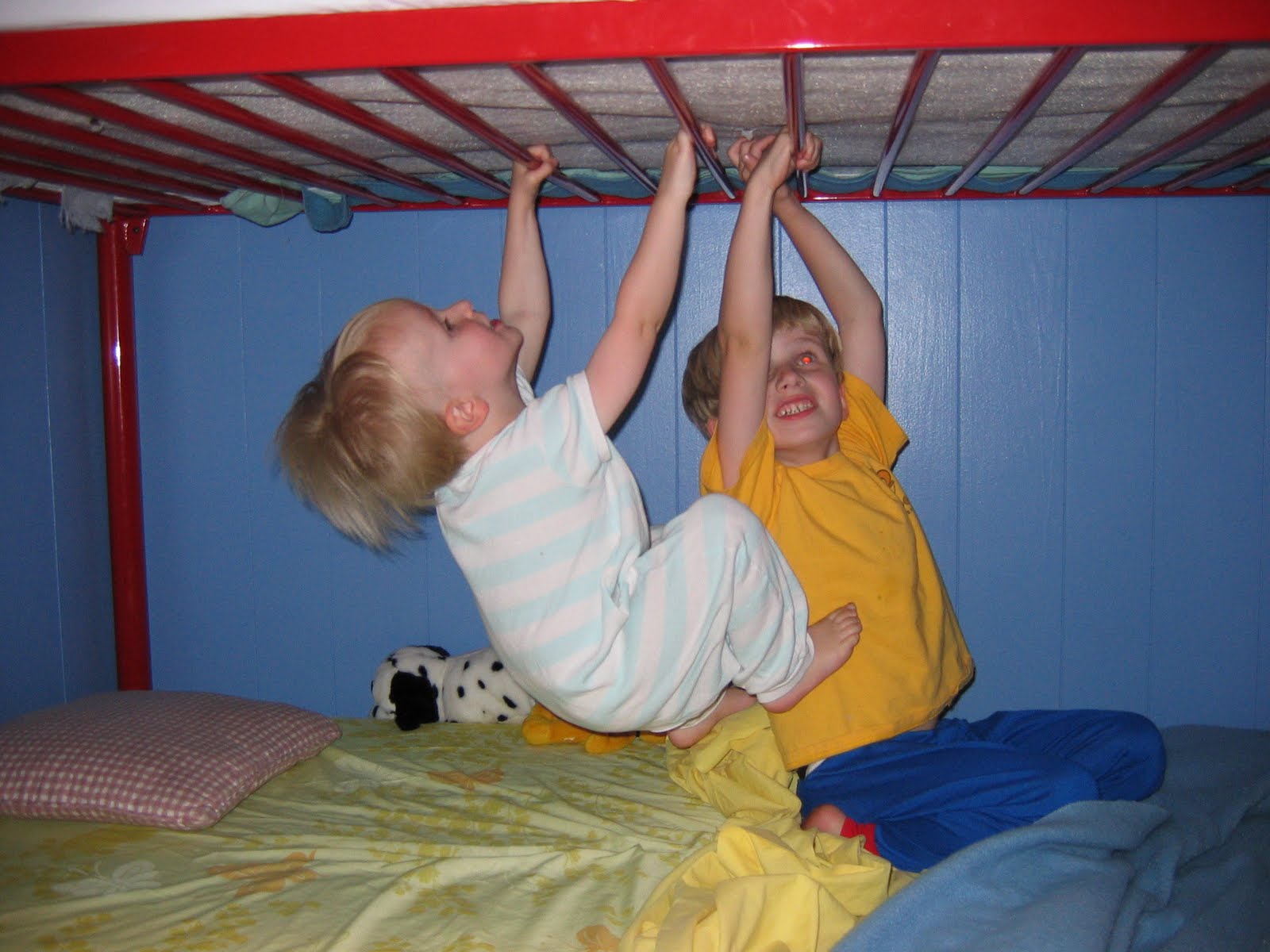
Later, I quit teaching and quit hanging out with youth in the inner-city in order to “slow down and have kids.” Boys, to be exact. You know, the action-verb boys. Instead of getting into bed, they swing from the bottom of the bunk and then drop onto the bed, squealing with delight. Coming down from either bed involves alternative routes from the ladder, and often a fireman-style slide down the bar on the bottom corner. When I’d help Jo Jo out of the van at two, he’d stop and yell, “TO INFINITY AND BEYOND!” before leaping into my arms. Now he just repels out of the van, his right hand clutching the seatbelt behind the driver seat, of course always clad in his army fatigue jacket.

Three mornings ago I was alerted that one of the boys was up when I heard a soft tapping on the bathroom door. I looked down to see four small fingers slowly sliding underneath the crack into the bathroom. I chuckled and opened the door. My four year-old was lying on his side, of course in army fatigue pajamas. “Shut the door,” he said calmly. I opened it 30 seconds later to find him in the same exact position, but now with a sword in his hand. Of course, he couldn’t just lie there and wake up, he had to lie there and fight evil forces!

The other night my boys were looking for something to do. They asked if I’d play a game of air hockey with them. Of course I would. I began to play against Evan, who is quite good. I was playing slower that night because Jo Jo was sitting in my lap. In my mind I contrasted this scene with my playing fast and competitively with those teenage boys at the drop-in center. I was a different person then! I knew I’d bond with those boys if I played hard and well. Now I was growing closer to my own boys by just playing. I was showing up and hitting the puck. When I play with Jo Jo, of course my reaction time is purposefully slower. But I’m in the game. I’m letting some get by… anything to keep that ear-to-ear grin going across the air hockey table.

At times I wonder about those boys from the drop-in center, and what twists their lives have taken. This last Halloween, my two little Super Heroes and I were at our church’s Harvest Party. While my caped crusaders were running around with some other similarly-clad boys (see my article “Keeping Their Capes On”), I went to prepare their hot dogs. A young man came in with his wife or girlfriend, possibly her mother, and a small child in his arms. He plopped himself down across from me, apparently needing a breather. I greeted him and he, me. Then he peered closely at me and asked, “Have I met you before?” I wasn’t sure. I looked at this handsome man in his mid-twenties, his baby boy snug against his side.
“I’m not sure… What is your name?”

“Rashaad.”

“RASHAAD!? I remember you! From the drop-in center on Dekum!” Bingo. That was it. He remembered me and my husband from those Saturday nights. Rashaad was a very quiet boy who, with his twin brother, would get dropped off each week by their grandmother. They’d play serious basketball and showed real talent. We never got to know Rashaad and his brother, but I remembered the big grin and the space between his front teeth. Yep, same nice boy. Similar Adidas gear. Only now, he had a good full-time job, a girl friend he was planning to marry, and a son in his arms. He was still a man of action, but he, too, was slowing down his game.

The Weaving


I’ve been thinking lately about baskets. In Hawaii there are many kinds of baskets. The ones I notice most-frequently are the loosely woven baskets by craftsmen on the Kona wall or at the market. They’re made of palm branches and start off green and loose, and over time become brown and brittle. When a piece runs out, the artist pulls out another frawn and overlaps it, so you cannot see where one piece ends and another begins. It’s just a circular, beautiful basket.
The people in our lives are like layers of those branches. They stay for a while, and mesh themselves in comfortably to the walls of our lives. Then, they leave. They may return again later for a season, or they may not. As building managers of a residential dorm at YWAM’s University of the Nations, we have stayed for the last 15 months while families have come and gone from Building 1. Some families we become closer to, while others we miss out on sharing a friendship. They change each quarter. Every now and then, there’ll be a family that stays longer for some reason.
Such was the case with our Norwegian neighbors, with whom we shared our lives for six months. Jarle (pronounced Yarle’) and Ashild (O’sold) won our hearts quickly with their five month old baby, Julia and her equally adorable toe-headed big sister, Live’ (Leeva). When Julia had a fever over 104 degrees for several days, we suggested a doctor who offered discounts to YWAM missionaries. I came in and prayed for their baby one night when she continued, again, her weak cry. Soaking wash cloths in tepid water with vinegar, I showed Ashild how to wrap the baby’s legs and pull the fever down and away from her vital organs. This technique was taught to me by a Swiss neighbor friend when our son Josiah was with high fever a few months earlier. Love and trust was woven in to the basket late that night.
At Easter time, I did what has become a tradition: I invited all the children from around the world who live in our building and the surrounding ones to join us for the American tradition of Easter egg dying. With my sons, I taught them how to color them, and then we pulled out the Resurrection Eggs and recalled the very first Easter story. Live’ joined us at that time in April, coloring an egg with her mama.
When Jarle needed advice about a car, Randy told him where to go in town to get it to pass the emissions quality test, and what types of things they check in the American system.
In June, I went to the end of year celebration of Foundation School to join the families-now-friends from our building as their children performed at the event. Jarle’ led worship first on his guitar, singing out with his soft Norwegian accent. Ashild, who taught the preschool class, handed out darling “Armor of God” pieces to her daughter as well as other friends like Rachel, our friend Gavin’s little sister. Eventually, the older kids like Gavin and David performed a hip-hop dance. I cheered with their proud parents.
We congratulated kiddos and prepared to hug the parents, again, as they packed up for outreach. And then, those families left. In a flurry of early-morning airport runs after days of packing, and room inspections and hugs and tears and prayers all around, they left. I felt as if my basket was unraveling.
Except for Jarle and Ashild. On a different schedule, they were leaving in a week. They got to see us clean up and pack up to move off campus. Semi-settled into our new condo, we invited our Norwegian neighbors for dinner. I delighted in having a full kitchen again, and prepared one of our favorite back-home dinners: grilled rosemary chicken, Trader Joe’s cornbread and the slow-cooked baked beans, a family recipe. The dads and some of the kids swam in our pool, while the moms and some of the kids (like our son Josiah in a cast) visited on the pool deck. They blessed us with marshmallows for roasting and chocolate macadamian nuts for savoring.
But the best part of the evening? It was when they looked at us over dinner on our lanai and said, “You have done what you said you would do. You have been like parents to us.” Randy and I glanced at each other, a bit surprised. “When we first came, you told us all that you wanted to be like a mother or a father to the young families in this building. You have done that! You did it when you prayed for our daughter, when you loaned us childrens’ Tylenol, or in so many encouragements along the way.”
What an eye-opener. These guys had been with us longer than the other families, and had seen us greet and hug goodbye two whole groups of families. They had heard us when we weren’t doing well as parents or when we grew weary of our 400 square foot apartment, and they’d seen us when we were building jigsaws and reading stories to our boys. Ashild told me, “You are an awesome mom. You are to your boys and you have been like that to me. Thank you!” We hadn’t really thought about it, we just kept doing what we felt to do as building managers who have a heart for families.
Though I knew these sweet friends would soon be climbing on an airplane, there was something that came full-circle that night. Maybe it took their leaving to do it, or maybe our all being off campus for some larger perspective, but there was a mutual blessing, a giving and receiving, and a completing of a basket. It was good and beautiful. We were grateful.
Since that evening, I have been in Ohana Court worshipping on a Monday morning, noticing hundreds of new faces. We now live off campus so we are not as closely-connected to the new families. As much as we love our new condo, we miss that camaraderie, of hearing everybody’s business whether you want to or not, and of being there for each other. I remember recognizing the back of Dave’s head or seeing whom I thought was Farrell in the distance, but it was not. They were in Japan and Cambodia, and these were new faces. Friends to come for a weaving yet to be.

Sunday, February 20, 2011

Richards Family Adventures: Over the Pacific on Our Way Home (Hellos and Goodbyes)

facebook.com
Richards Family Adventures: Over the Pacific on Our Way Home (Hellos and Goodbyes)

Over the Pacific on Our Way Home (Hellos and Goodbyes)


January 5, 2011
I haven’t blogged in months, but feel the need to do so now. I feel this strange mix between gratefulness and sadness, between friends gained and friends lost. Ohana soon-to-see and ohana left- behind.

It took an 11 year-old boy to jump-start my thinking, and my emotions. Little boys (and even big boys) are known for not being in touch with their feelings—or knowing how to express their feelings when they have them. We were all getting ready to go to bed on our last evening of a New Year’s visit to Portland. These are dear friends with whom we stayed our last few nights prior to embarking on this journey, who drove us to the airport on our send-off to YWAM 15 months ago. These are the same friends who were able to scrape together the days off-and the money-earned to fly to Kona—our only visitors—around our oldest son’s 11th birthday.

It was that son’s best friend who now shook my consciousness a little. It wasn’t by what he did, but by what he could not do. When asked by their mother to say goodbye to Evan and Jo Jo, Adin, the younger boy whom Fetta refers to as “my verbal son,” came down to our basement digs and stood tall, looking us in the eyes. “I want to say goodbye and to wish you safe travels on your journey.” Wow. His older brother? “He is in bed; he cannot bring himself to say goodbye to Evan.” Huh. After some hesitation, Evan wandered in to Noah’s room. They chatted about whatever 11 year-old boys do, and said a brief goodbye.

I pondered this as I got up early the next morning, allowing time to run upstairs and catch Noah before he headed to school. I just had to get a big hug in with this best-friend-of-my-son. You see, this non-verbal boy almost knocked me over when we first arrived, his hug was so welcoming. It wasn’t at their door; it was on the driveway as he flew out of his house. Kinda like Evan when he decided he couldn’t wait to greet Noah at their Kona hotel six weeks earlier—he had to surprise him at the airport, with one of the biggest smiles I’d seen on his face since we started this adventure a year earlier.

Knowing leaving was hard, we decided to leave a couple of Kona candies with these special friends: two chocolate-covered mac nuts for two wonderful brothers. Together with a card we each signed, we hoped to sweeten the sadness that our exit would leave behind.

This ease-in-welcoming and difficulty-with-leaving was repeated as we had dinner with our former neighbors. Cherie and Kerie were happy to catch us briefly after a dessert at our old house, but wanted more time. They invited us over a few nights later after a busy Sunday afternoon. The conversation was easy over beef stroganoff, and our boys quickly flew upstairs for Lego-building and Star Wars-watching (two of their favorite pastimes, which they shared in common with the neighbor kids). At some point in the conversation, Cherie asked how long we’d continue on this teaching-children-overseas adventure. She said nothing at our “2-5 years” response, but when I talked about the improved-decorating of our former-home-now-rental, she quipped, “All the better for you to enjoy when you come home!”

“They’re having a hard time with this,” I thought to myself. Randy seconded this view when he noted Ashley fleeing up the stairs to keep from crying as we left.
From the Portland area we made our way up the rainy highway towards Seattle, including the longed-for stop at Krispy Kreme Doughnuts. My sister and her family were again so happy to see us. I quickly accepted that my body was exhausted. Now on our last night of our first vacation from YWAM, I recounted how many friends had welcomed us on this trip: sixteen households had happily hugged us and then said goodbye. I was fine with this. Exhausted, but fine.

After an early-to-bed prior to an early-to-rise for Sea-Tac Airport, I began to crack. I was side-swiped with sadness. I found myself weeping at not-big things. When my sister stopped me for one final hug in front of Hawaiian Air, I broke. Jolie, my sweet sister, had made a special trip to Whole Foods for garnishes for her gourmet soup and clotted cream for her anglophile sibling. Now a few hours later, she was smiling her winning smile as she squeezed a goodbye. I could not hold back the tears. I realized this was harder than I thought. I hadn’t counted on being broad-sided with those feelings. Not only was my body not accustomed to the cold, damp climate (I’d gone to bed early with Vitamin C), but my emotions were not handling these goodbyes.

I settled in to my airport seat to await our next chapter when an idea struck me: the Frango chocolate in my purse--a sweet sentiment from my Seattle sister. Like our intention with the Kona candy left for our boys’ buddies, I was now comforted by a similar act. I slowly ate the chocolate, savoring the memories of each hello and goodbye.

Praise be to the God and Father of our Lord Jesus Christ, the Father of compassion and the God of all comfort, who comforts us in all our troubles, so that we can comfort those in any trouble with the comfort we ourselves have received from God {via my sister}. II Corinthians. 1:3-4 Here are some of the loved ones we got to hug on during our first trip home in 15 months.
Evan hugged by Cousin Ike at Christmas
Greetings from Uncle Rob and Aunt Sharon, Christmas dinner at brother Andrew’s.


Christmas hugs for Anna Linda Hugs with neice Claire

Hugs with Grandma and her four children and hubbies

Hugs with Dad!
Hugs from teacher friend Sue Carlson at Cedar Tree on a frosty first-day-of-school in 2011

Guys Going Goofy at the Geisel’s

Hugs in our former home with good friend/hostess Natasha Poonka

Hugs with former neighbor Barb Sauer
Getting Increasingly Goofy with Marcus in our former home

Wonderful histories with Neighbor Mike, Phillip and Andrew Poonka


A warm Hug on a Cold Day from Niece Sauni
From Zimbabwe to Tonga and back: Randy and sister Kim exchange a New Year’s hug

A welcome visit from our Kiwi-Singapore City Bible friends Lois and Steve Ross (whose daughter, Grace, was in Evan’s preschool class)


HUGS FROM FORMER NEW SONG FRIENDS, ROOMMATES, AND PASTORS


On the way home from Albany, hugs at sunset